
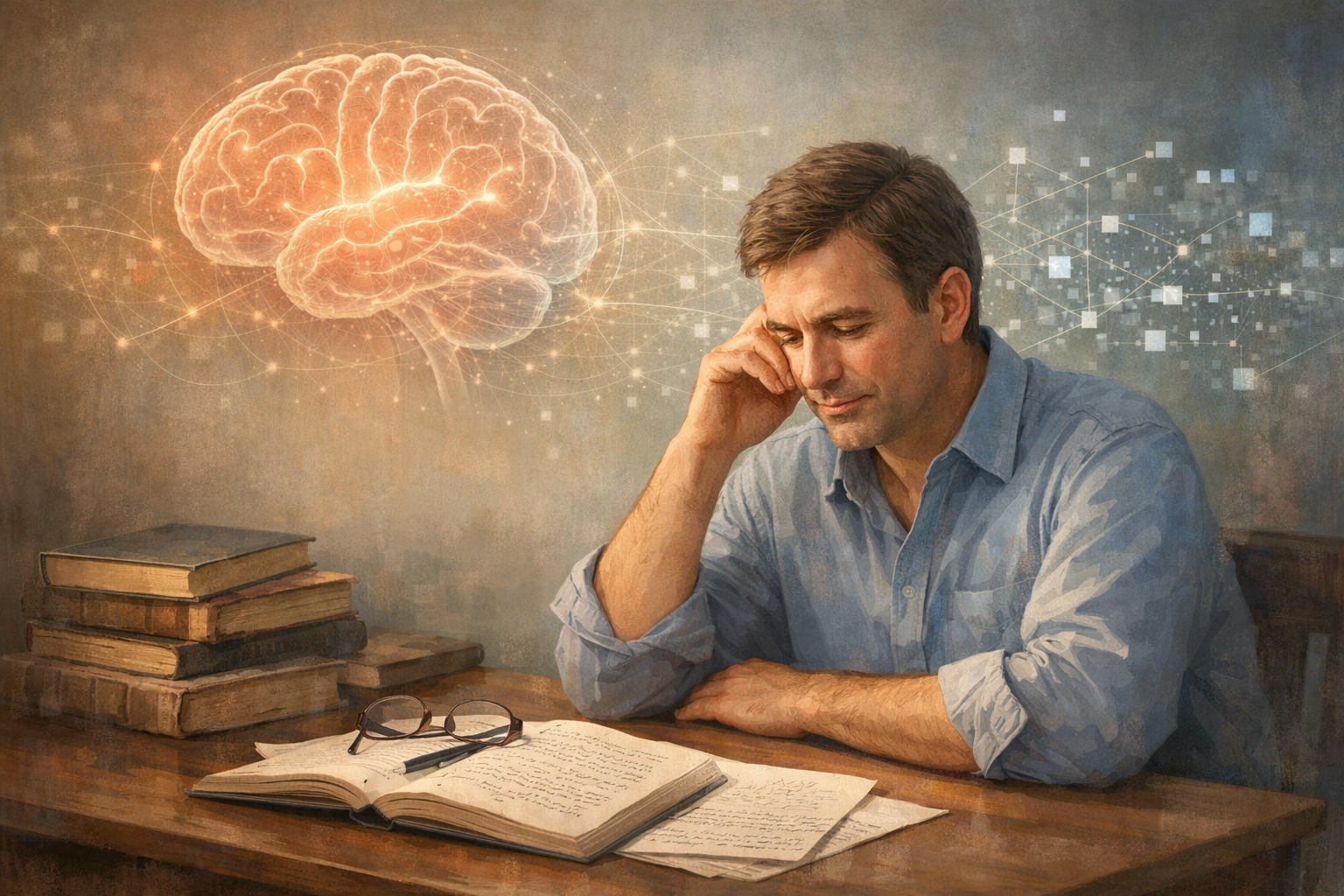
A few years ago, I used to write and share a lot about Artificial Intelligence here on LinkedIn. At that time, I was actively contributing to AI discussions and learning alongside the community.
Back then, the focus was mostly on where AI was taking us. But at some point, I started feeling uncomfortable with the direction of those conversations.
We were moving very quickly from human intelligence to artificial intelligence, yet very little attention was being given to how human intelligence made all of this possible in the first place.
So I paused.
Instead of going deeper into tools or models, I tried to work backward. I wanted to understand the source. That curiosity pulled me into neuroscience. I spent years reading, revisiting fundamentals, and trying to understand how the human brain actually learns.
It still amazes me that three pounds of biological matter shaped thousands of years of human evolution — how we think, how we live, and eventually how we built machines that now learn from us.
And now, here we are.
We are clearly in the middle of an AI revolution. Slowly moving away from the Information Age and stepping into the AI Age.
When I formally studied Artificial Intelligence as part of my graduate program, I honestly thought learning would become easier.
It didn’t. It became harder.
AI didn’t remove effort. It removed excuses. It forced me to be clearer in my thinking. That pushed me to spend even more time understanding how learning really works in the human brain.
Recently, I ran into a problem I had been stuck on for more than 3 years. Almost as a last attempt, I tried using AI tools to approach it differently. One couldn’t help at all. Another suddenly helped me see the problem from a completely new angle.
That moment stayed with me.
AI can give answers quickly — but only when we ask the right questions. And when we don’t, it quietly exposes how shallow our thinking can be.
During my studies, I noticed something simple. The people who learned the most weren’t using AI to get answers. They were using it to test their understanding and that was reflected in my 100 days challenge also.
AI helped us ask better questions. Compare ideas. Challenge assumptions. Explore areas we hadn’t considered before.
It didn’t replace thinking.
If anything, it demanded better thinking.
In both study and work, this difference matters.
AI doesn’t reward speed.
It rewards clarity.
Over time, this has also shaped where I want to focus next. I plan to write more about how AI can support kids and students in the AI, not by replacing learning, but by strengthening how they think, explore, and grow. I’m also planning to specialize deeper in this space and continue my own learning alongside it.
The future isn’t about who uses AI. It’s about who knows how to think with it.
If there are specific studies or learning challenges, let me know. I will write in future post.
How do you use AI when you’re learning something new?

Leave A Comment